Central Banks, "Legalized Theft," and the Bitcoin Life Raft: Deep Dive with Robert Breedlove
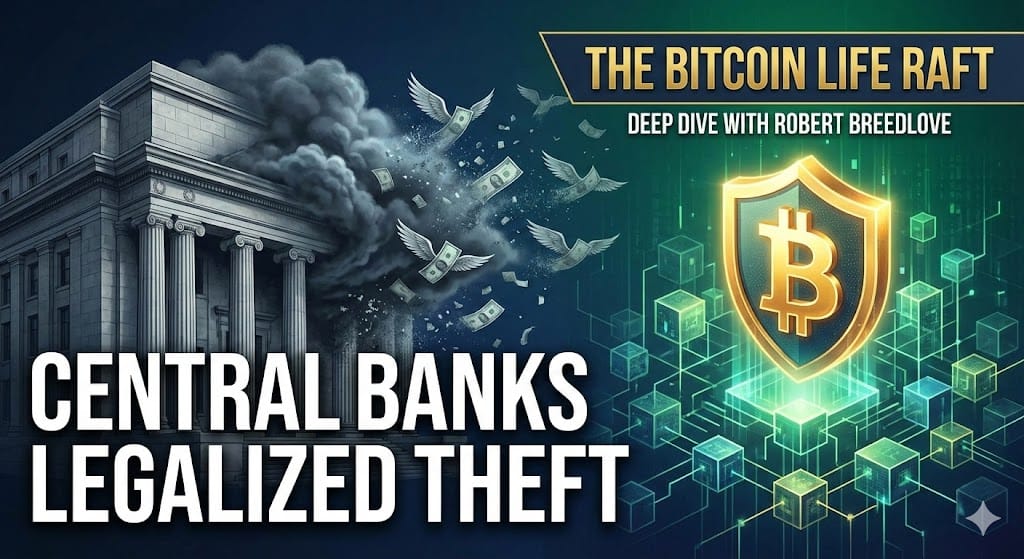
If you’ve ever felt like the economy is rigged against you or that your money buys less every year regardless of how hard you work, you aren't imagining things.
In a recent, hard-hitting discussion, Tom Bilyeu sat down with philosopher and Bitcoin maximalist Robert Breedlove to dissect the machinery of modern money.
Their conversation goes far beyond typical financial advice.
It’s a philosophical deep dive into the nature of "gangs," the morality of private property, and why Bitcoin might be the only true exit ramp from a broken system.
Here are the top takeaways from this eye-opening episode.
Buy & Sell Bitcoin, Dollar Cost Average management abd pay your bills with Bitcoin on the the best Bitcoin only Exchange.
1. Central Banks as the "World's Biggest Gangs"
Breedlove opens with a provocative thesis: The world is run by gangs, and nation-states are just the biggest ones.
He argues that central banks (like the Federal Reserve) are arguably the most problematic institutions in existence. Why? because they operate what he calls a "counterfeiting cartel."
- The Mechanism: Central banks control the money supply and interest rates (the price of time). Unlike a free market where prices are discovered, these rates are centrally planned.
- The Result: When a central bank prints money, they are effectively "stealing" purchasing power from everyone holding that currency. Breedlove quotes a New Zealand central banker who once candidly admitted, "Central banking is a great business; we print money and people believe it."
2. Inflation is Not "Growth"—It’s Theft
One of the most critical points made [16:54] is that inflation is a hidden tax.
Breedlove explains that when the money supply expands, the value of the currency drops. This creates a "Cantillon Effect" where:
- Asset Holders Win: The rich, who own assets (stocks, real estate), see their net worth inflated.
- Wage Earners Lose: Workers and savers see their purchasing power evaporate.
This dynamic creates a permanent caste system where the rich get richer because of the system, not just their innovation, while the poor are systematically robbed of their labor.
As Breedlove puts it, if the government is deficit spending, they are stealing from you.
3. Socialism vs. Capitalism: A Spectrum of Property Rights
The conversation takes a fascinating turn into political philosophy [35:03]. Breedlove defines the political spectrum not by "left vs. right," but by respect for private property:
- Capitalism: The universal respect for private property and consensual trade.
- Socialism: The institutionalized aggression against private property.
He argues that socialism fails because it tries to replace market incentives with coercion.
You cannot force people to work for free, and once you violate the principle of consent (stealing property or labor), society begins to degenerate, often leading to violence and "murderous" outcomes as history has shown with regimes like Stalin’s.
4. Bitcoin: The "Perfect" Private Property
So, what is the solution? For Breedlove, it is Bitcoin. He describes Bitcoin as the "child of the internet and gold" [48:22].
- Gold’s Flaw: Gold is great at storing value over time (scarcity) but terrible at moving across space (it’s heavy and physical). This physical limitation is what led to paper money and eventually central banks.
- Bitcoin’s Solution: Bitcoin fixes this by being absolute scarcity (only 21 million coins will ever exist) that can move at the speed of light.
Breedlove argues Bitcoin is the first true form of private property that cannot be seized, debased, or printed away.
By moving to a money that government cannot print, you effectively "defund the war machine" because governments would have to rely on direct taxation—which citizens resist—rather than the invisible tax of inflation.
5. The Future: Optimism Despite the Chaos
Despite the heavy topics, the conversation ends on an optimistic note.
Breedlove believes that humans are adaptive.
Just as the printing press disrupted the medieval church, Bitcoin is disrupting the nation-state model.
He foresees a future where:
- Incentives for violence decrease because wealth (Bitcoin) becomes harder to steal.
- We may move toward smaller, experimental jurisdictions (like free city-states) rather than massive, coercive nation-states.
- Technology and AI could usher in an era of super-abundance, forcing us to find new meaning beyond just "survival."
Final Thoughts
This conversation is a wake-up call to understand the "game" of money.
As Tom Bilyeu summarizes, if you don't understand that deficit spending and inflation are forms of theft, you will keep voting for the very policies that impoverish you.
Your Bitcoin, your rules.
Buy it, sell it, hold it, spend it, and get it delivered straight to your wallet in minutes.
Pay bills with Bitcoin and never rely on a custodial middleman again.
Step into self-custody with Bitcoin Well.
Watch the full episode here:https://www.youtube.com/watch?v=1gnIbVFnuCY

Comments ()