Maintaining a Personal Code When Institutions Fail
There comes a point when the rules stop working.
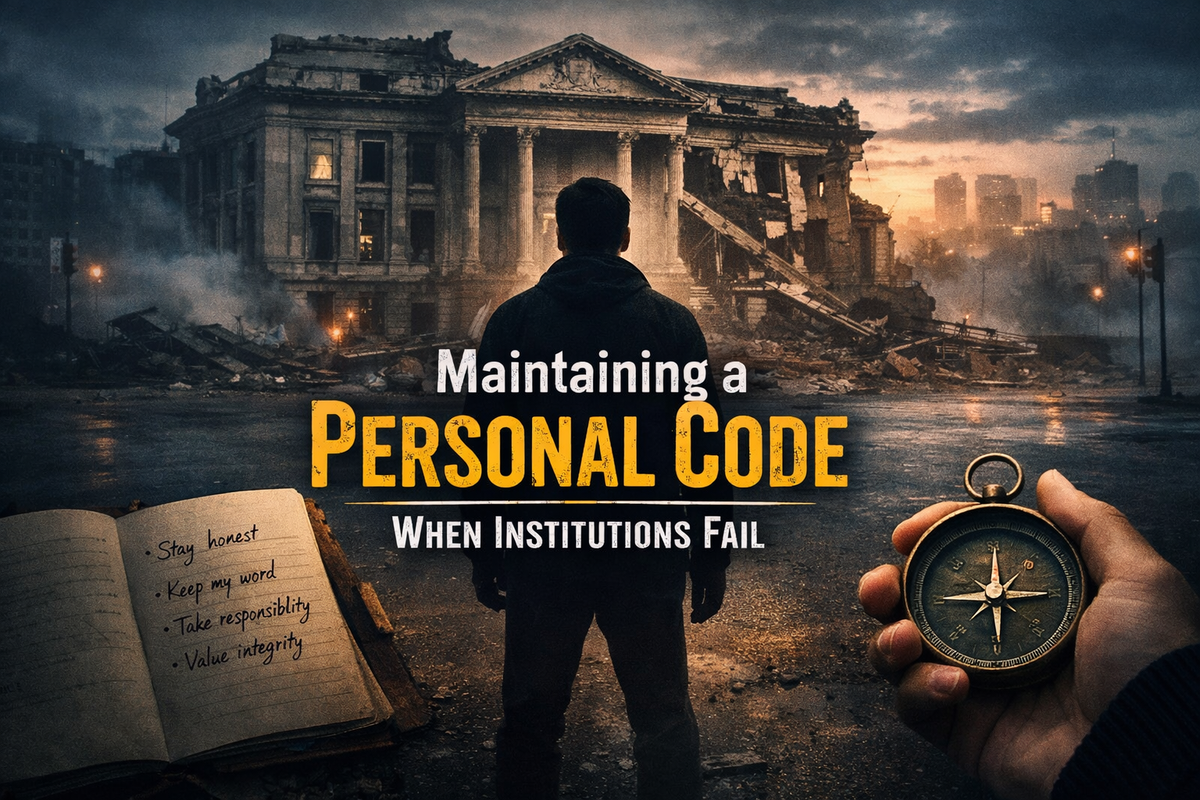
Not because laws disappear overnight, but because they stop aligning with reality.
Processes become performative. Incentives invert. Authority fragments.
What once guided behavior becomes noise.
In those moments, survival is not about rebellion or compliance.
It is about having a code.
Institutions Fail Before They Collapse
Most people expect failure to look dramatic. It rarely does.
Institutions usually fail quietly, through friction, delays, contradictions, and selective enforcement. The rulebook remains thick, but the spirit is gone. Trust erodes long before headlines admit it.
When that happens, external rules stop providing clarity.
They still exist, but they no longer answer the real question people are asking:
“What is the right thing to do right now?”
Why External Rules Stop Working
Institutions are designed for averages. They assume stability, predictability, and shared values. During periods of stress, those assumptions break.
Rules become:
- Inconsistent across contexts
- Applied unevenly
- Optimized for optics instead of outcomes
- Weaponized by incentives rather than principles
At that point, following the rules does not guarantee integrity. Sometimes it guarantees the opposite.
This is where most people freeze.
They were trained to outsource judgement.
A Personal Code Is Internal Infrastructure
A personal code is not a manifesto. It is not a brand. It is not something you post.
It is a small, internal rule set that answers three questions:
- What do I do when incentives are distorted?
- What do I refuse to do, even if rewarded?
- What do I protect, even if unrecognized?
When institutions fail, internal rules replace external ones.
Not loudly. Quietly.
What a Personal Code Looks Like in Practice
A functional personal code is simple enough to remember under pressure.
Examples:
- I do not lie to gain short-term advantage.
- I keep my word, especially when it costs me.
- I do not outsource responsibility for my actions.
- I build skills that make me useful, not just compliant.
- I choose long-term trust over short-term wins.
These are not moral slogans.
They are operating constraints.
They reduce decision fatigue when systems are unreliable.
The Psychological Advantage of a Code
Without a personal code, people drift.
They chase incentives, mimic authority, and rationalize contradictions. This creates internal fragmentation, anxiety, and eventually burnout.
With a code:
- Decisions become faster.
- Regret decreases.
- Identity stabilizes.
- You stop needing permission to act correctly.
This is not about being rigid.
It is about being anchored.
Why Codes Matter More in the Fourth Turning
Periods of institutional breakdown reward adaptability, but punish ambiguity of self.
People who rely entirely on external validation struggle when signals conflict.
People with a personal code can navigate gray zones without losing themselves.
They are not louder. They are not angrier.
They are harder to move.
A Quiet Form of Resistance
Maintaining a personal code is not about fighting the system.
It is about remaining legible to yourself when the system becomes incoherent.
You do not need to announce it.
You do not need consensus.
You do not need approval.
You need consistency.
When institutions fail, character becomes infrastructure.
And the people who endure are rarely the loudest.
They are the ones who knew who they were before the rules stopped making sense.

Feel like the internet knows too much about you?
It does... but it doesn’t have to stay that way.
Digital Disappearance is your survival guide for reclaiming your privacy in a hyper-connected world.
Comments ()