The Apartment Prepper’s Guide to Energy Independence
Here is a guide to building a discreet, space-efficient backup system designed specifically for apartment living.
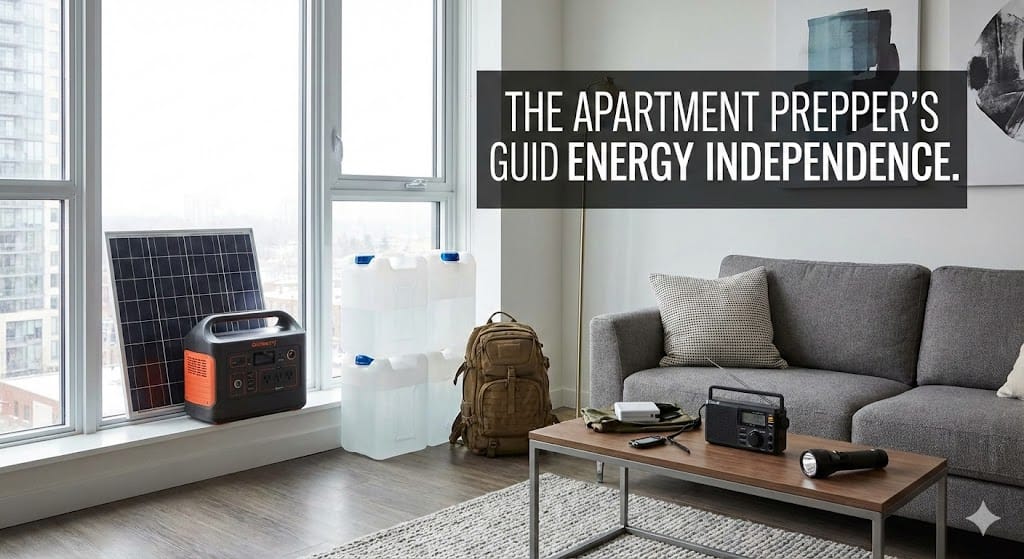
How to build a backup power & survival stack in less than 10 sq. ft.
If you live in an apartment, "prepping" looks different.
You can't bury a 1,000-gallon propane tank in the backyard, and running a gas generator on your balcony will likely get you evicted (or poison your neighbors).
You need a system that is silent, smokeless, and compact.
Here is the blueprint for a minimum viable backup system that fits in a closet but keeps you running when the grid goes down.
1. The Power Core: "Solar Windows" & Battery Banks
Forget roof-mounted arrays.
In an apartment, your "power plant" needs to be mobile and modular.
The Battery: Your Silent Generator
You need a "Solar Generator"—essentially a high-capacity lithium battery with an inverter attached.
- The Sweet Spot: Look for a unit with 1000Wh to 2000Wh capacity. This is enough to power your laptop, router, phone, and LED lamps for 2-3 days sparingly.
- Top Picks:
- EcoFlow Delta 2: fast charging and fits on a bookshelf.
- Jackery Explorer 1000 v2: Rugged and reliable.
- Bluetti AC180: Good value for the capacity.
The Input: Solar Windows (The Hack)
True "solar glass" (transparent windows that generate power) is still largely commercial tech. For now, you use the "Window Hang" technique.
- The Gear: Buy flexible or folding solar panels (100W–200W).
- The Setup: Instead of mounting them on a roof, you use suction cups or s-hooks to hang them inside your south-facing window or drape them over your balcony railing.
- Reality Check: You will get about 40-60% efficiency through window glass compared to direct outdoor sun. It’s not perfect, but in a blackout, 60 watts of trickle charge is infinitely better than zero.
2. Water: The "Stack & Tub" Strategy
Water is heavy and takes up massive space. In an apartment, you can't store 55-gallon drums. You need a two-tier system.
Tier 1: The Daily Stack (WaterBrick)
Standard round jugs waste space. Use WaterBricks or AquaBricks.
- Why: They are rectangular and interlock like Legos. You can stack them floor-to-ceiling in a coat closet or slide them under a bed.
- Capacity: 3.5 Gallons per brick. A stack of 4 bricks = 14 gallons (2 weeks of survival water for one person) in the footprint of a single shoebox.
Tier 2: The Emergency Expansion (WaterBOB)
This is for when you know a storm is coming.
- The Gear: The WaterBOB (or similar bathtub liner).
- How it works: It’s a giant sterile plastic bladder you throw in your bathtub and fill from the tap before the water cuts out.
- Capacity: Up to 100 gallons. It turns your useless tub into a massive reservoir of potable water.
3. The Minimum Viable Urban Stack
Beyond power and water, you need a "stack" of tools specifically chosen for high-density urban environments.
- The "Sillcock Key" (4-Way Water Key):
- What it is: A small cross-shaped metal tool.
- Why you need it: Commercial buildings (like your apartment complex) have external water spigots that don't have handles—they require this key. In a dire emergency, this $10 tool gives you access to water from the sides of commercial buildings.
- USB-Rechargeable Arc Lighter:
- Matches get wet. Butane runs out. A plasma lighter recharges from your solar battery.
- Localized Offline Maps:
- Download Organic Maps or Google Offline Maps for your specific city. If cell towers jam, you need to know which streets are passable.
- Apartment-Safe Heat:
- Mr. Heater Buddy: One of the few propane heaters rated for indoor use (with an oxygen depletion sensor). Warning: You must still crack a window and have a battery-powered Carbon Monoxide detector running.
- The "Blanket Fort": If you can't run heat, isolate one small room or set up a tent inside your living room. Heating a small tent with body heat is easier than heating a 900 sq. ft. apartment.
4. The "Go" Sequence
When the lights go out, don't panic. Execute this sequence:
- Fill the Tub: If water is still running, deploy the WaterBOB immediately.
- Conserve: Unplug everything. Plug only your router and phone into the battery.
- Blackout Curtains: If it's hot, block the sun. If it's cold, block the draft.
- Intel: Check local news/radio. Don't drain your phone scrolling social media; get the facts, then turn it off.


Comments ()