The Rise of AI Managed Cities: Convenience or Control?
Cities are entering a new phase of automation.
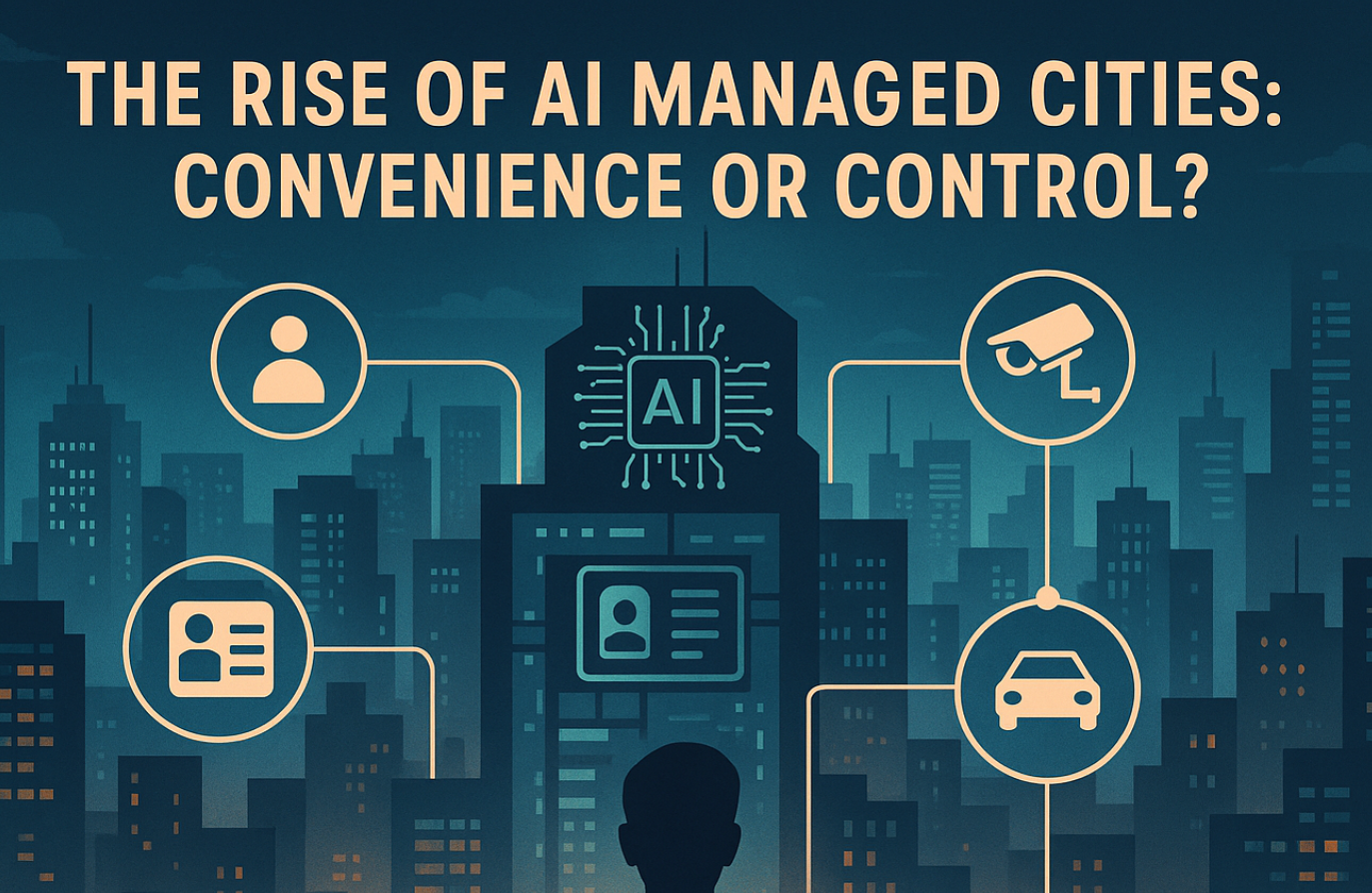
What began with smart traffic lights and connected utilities is evolving into fully AI managed urban environments.
Governments, planners, and large corporations promise efficiency, safety, and convenience.
But the deeper question is whether these systems create a form of invisible governance that concentrates power and monitors citizens by default.
Below is a clear look at what is coming, why it is happening, and what it means for personal freedom.
What AI Managed Cities Promise
Supporters of AI driven city infrastructure point to real benefits.
Seamless transportation
Traffic optimization, automated tolling, predictive congestion mapping, and smart public transit routes that adapt in real time.
Efficient resource usage
AI balancing of electricity loads, automated water management, digital metering, and waste systems that adjust to neighborhood patterns.
Predictive safety
Camera networks and pattern recognition tools flag disturbances, suspicious behavior, or emergency risks long before humans ever notice.
Government services that “just work”
Digital IDs, instant permit approvals, automated fines, tax collection, and real time citizen service portals powered by AI.
This is the story told to the public. A clean, efficient, optimized future. But a different story unfolds when you examine the machinery behind these systems.
The Tradeoff: Visibility Over Autonomy
AI managed cities require sensors, cameras, identity systems, and continuous data capture. To automate a city, the city must constantly watch itself. That means watching you.
Smart cities centralize data
Everything is fed into a centralized platform that builds detailed profiles of movements, habits, payments, communications, and social connections.
Digital IDs become mandatory
To access transit, government services, healthcare, banking, or public buildings, a verified identity token becomes necessary. Convenience becomes dependence.
Automated governance replaces due process
AI may issue fines, flag behaviors, restrict access, or categorize risk levels without human oversight.
Predictive policing normalizes preemptive enforcement
Algorithms determine who might cause trouble, where crime might occur, and what behavior patterns indicate risk. This becomes justification for policing people who have done nothing.
The convenience is real. So is the control.
When Systems Become Self Reinforcing
Once cities rely on AI for core operations, shutting off these systems becomes impossible. They become embedded, permanent, and opaque.
- Data gathered for traffic management can be reused for policing.
- Digital ID systems created for healthcare can be required for payments or travel.
- Cameras installed for public safety can be linked to facial recognition and cross referenced with tax or employment records.
- Automated governance decisions become unquestioned because “the algorithm is neutral.”
The architecture of the city becomes an architecture of surveillance.
Who Actually Owns the System?
This is where the stakes rise.
Most AI managed city platforms are not built by governments. The infrastructure is often owned, operated, or maintained by private companies:
- cloud providers
- security contractors
- telecom giants
- AI surveillance firms
- digital ID vendors
- payment networks
When critical city functions run on their servers, the line between public governance and corporate governance blurs.
Data becomes currency. Citizens become users instead of participants.
The Subtle Shift: Citizenship Turns Into Permission
In a traditional society, rights exist by default and are removed only through due process.
In an AI managed smart city, access is granted by default and removed algorithmically.
The shift is subtle but profound.
A person in a smart city might wake up one morning to find:
- their transit pass disabled
- their payment account flagged
- their access to a building restricted
- their ability to register for services blocked
- an automated fine deducted automatically
- their digital ID temporarily suspended
No officer, clerk, or administrator is directly involved. The system acts, and humans comply.
This is the danger of invisible governance.
A Parallel Question: Can These Systems Ever Be Democratic?
For AI managed cities to avoid becoming instruments of control, several principles need to be non negotiable.
1. Transparent algorithms
Citizens should know how decisions are made, scored, or enforced.
2. Local storage and minimal data
A city does not need a real time social graph of every resident to operate efficiently.
3. Human oversight by default
AI should assist, not govern.
4. Opt out options
No one should be forced to participate in digital ID systems or city wide surveillance layers.
5. Decentralized digital identity
Identity must be citizen owned, not government or corporate controlled.
6. Analog fallbacks for essential services
A city should still function if servers go down.
Without these protections, convenience is simply the gateway to control.
The Big Picture: Automation Without Freedom Is Not Progress
AI managed cities are coming, and many advantages are worth embracing.
But society must avoid sleepwalking into a system where every movement, payment, or interaction is monitored and evaluated.
The question is not whether cities should use AI.
The question is who holds the power that AI centralizes.
If citizens do not own the systems, the systems will eventually own the citizens.
Your Bitcoin, your rules.
Buy it, sell it, hold it, spend it, and get it delivered straight to your wallet in minutes. Pay bills with Bitcoin and never rely on a custodial middleman again. Step into self-custody with Bitcoin Well.



Comments ()