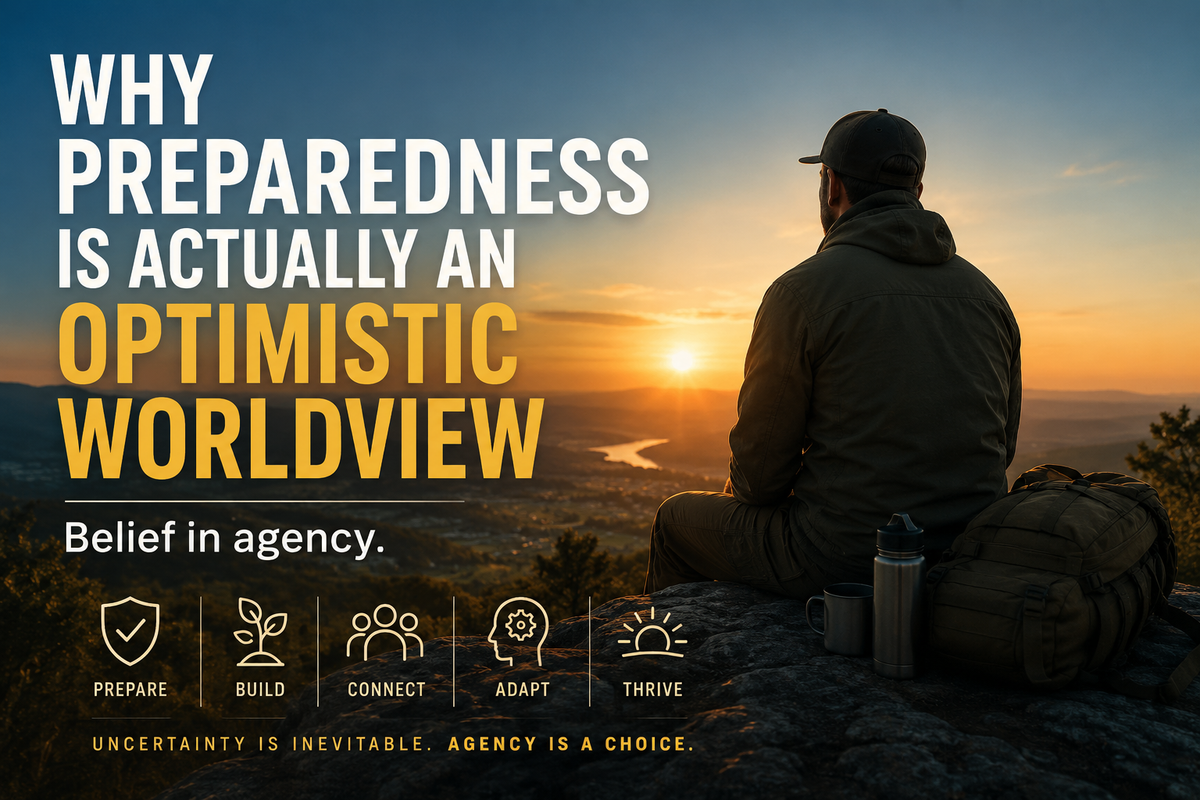
Why Preparedness Is Actually an Optimistic Worldview
In the late 1990s, preparedness became associated with fringe culture.
People pictured bunkers in the desert, canned food stacked to the ceiling, shortwave radios, conspiracy forums, and predictions about societal collapse. Hollywood amplified it. Media mocked it. Silicon Valley dismissed it as irrational thinking from people who “didn’t understand progress.”
But after spending more than three decades in technology, networks, digital systems, and watching how modern infrastructure actually works, I’ve come to a very different conclusion:
Preparedness is not a pessimistic worldview.
Learn about Survival in the Digital Age. Explore self-reliance, resilience, and how you can navigate uncertainty in an increasingly complex world. Survival isn’t hiding. It’s outsmarting the collapse. This is the launch pad!
It is one of the most optimistic worldviews a person can have.
Because preparedness is ultimately about belief in human agency.
That word matters: agency.
The belief that your actions still matter. That your decisions can influence outcomes. That individuals, families, businesses, and communities are not completely powerless in the face of uncertainty.
People who prepare for disruption are often portrayed as fearful. In reality, most of them are simply paying attention.
They understand something many modern systems quietly condition people to forget:
Complex systems fail.
Not because someone evil flips a switch. Not because civilization suddenly disappears overnight. But because all large interconnected systems eventually experience stress, fragility, bottlenecks, outages, financial shocks, cyberattacks, political instability, or simple human incompetence.
Anyone who has worked in technology long enough understands this intuitively.
You can build extraordinary systems. You can create redundancy. You can scale globally. You can automate almost everything.
But no system achieves permanent stability.
Servers go down.
Supply chains break.
Banks freeze.
Power grids fail.
APIs collapse.
Governments miscalculate.
Markets overreact.
Software ships with vulnerabilities.
Entire industries get blindsided by second-order effects nobody modeled correctly.
This is not doom thinking. This is operational reality.
The strange thing is that earlier generations understood this far better than we do.
My grandparents kept extra food in the house because shortages happened.
People learned practical skills because repair mattered.
Communities were more localized because resilience depended on relationships nearby, not just digital convenience.
Preparedness was normal.
Then somewhere along the way, modern convenience created the illusion that friction had been eliminated permanently.
You could summon food with an app.
Stream infinite entertainment instantly.
Replace skills with subscriptions.
Outsource memory to search engines.
Outsource navigation to GPS.
Outsource communication to platforms.
Outsource storage to cloud providers.
Outsource resilience to systems you neither own nor control.
Most people stopped noticing how dependent modern life had become on uninterrupted infrastructure.
Until disruptions started stacking up again.
The 2008 financial crisis exposed fragility in global banking.
The pandemic exposed fragility in supply chains.
Cyberattacks exposed fragility in digital infrastructure.
Inflation exposed fragility in household economics.
AI is now exposing fragility in knowledge work itself.
And what fascinates me is how differently people respond to this realization.
Some people become cynical.
Others become passive consumers of fear content online.
But a smaller group responds by increasing capability.
They learn.
Adapt.
Build.
Store.
Train.
Diversify.
Reduce dependencies.
Strengthen relationships.
Acquire practical skills.
Create optionality.
That is not fear-driven behavior.
That is optimism expressed through action.
Preparedness is the belief that adaptation is possible.
A person who builds a garden believes the future is worth investing in.
A person who learns offline skills believes human competence still matters.
A family that creates financial reserves believes tomorrow exists beyond today’s uncertainty.
An entrepreneur building multiple income streams is practicing preparedness.
A business decentralizing infrastructure is practicing preparedness.
A parent teaching their children resilience instead of helplessness is practicing preparedness.
At its core, preparedness is anti-fragility.
The goal is not to predict every disaster. That’s impossible.
The goal is to reduce catastrophic dependence on any single system, institution, platform, employer, or fragile assumption.
Ironically, this mindset often produces calmer people.
Because anxiety tends to rise when people feel completely dependent and powerless.
When your entire life depends on systems you don’t understand and cannot influence, uncertainty becomes terrifying.
But capability changes psychology.
Skills reduce fear.
Savings reduce panic.
Community reduces isolation.
Knowledge reduces manipulation.
Adaptability reduces helplessness.
Preparedness creates psychological stability because it restores a sense of agency.
That’s why I increasingly see preparedness as one of the healthiest responses to modern complexity.
Not because collapse is inevitable.
Not because disaster is guaranteed.
Not because society is ending.
But because mature adults understand uncertainty is permanent.
And optimistic adults prepare anyway.
The most dangerous worldview is not preparedness.
It is blind dependency disguised as convenience.
It is assuming systems will always work because they worked yesterday.
Assuming institutions will always remain competent.
Assuming economic conditions will remain stable indefinitely.
Assuming technology eliminates risk instead of redistributing it.
- Advanced VPN for a free, open internet.
- Built-in next-gen antivirus to stop malware, scams, and phishing.
- One app to protect your identity, privacy, data, and devices.
History suggests otherwise.
The people who navigate periods of instability best are rarely the people with the most confidence in centralized systems.
They are usually the people with the highest adaptability.
The builders.
The practical thinkers.
The people who maintain optionality.
The people who can operate when conditions change unexpectedly.
In technology, we call this redundancy.
In engineering, we call it resilience.
In investing, we call it diversification.
In survival, we call it preparedness.
Different language, same principle.
Real optimism is not believing nothing bad will ever happen.
Real optimism is believing human beings remain capable of responding intelligently when it does.
Comments ()