How One War Triggers Five Others (Chain Reaction Explained)
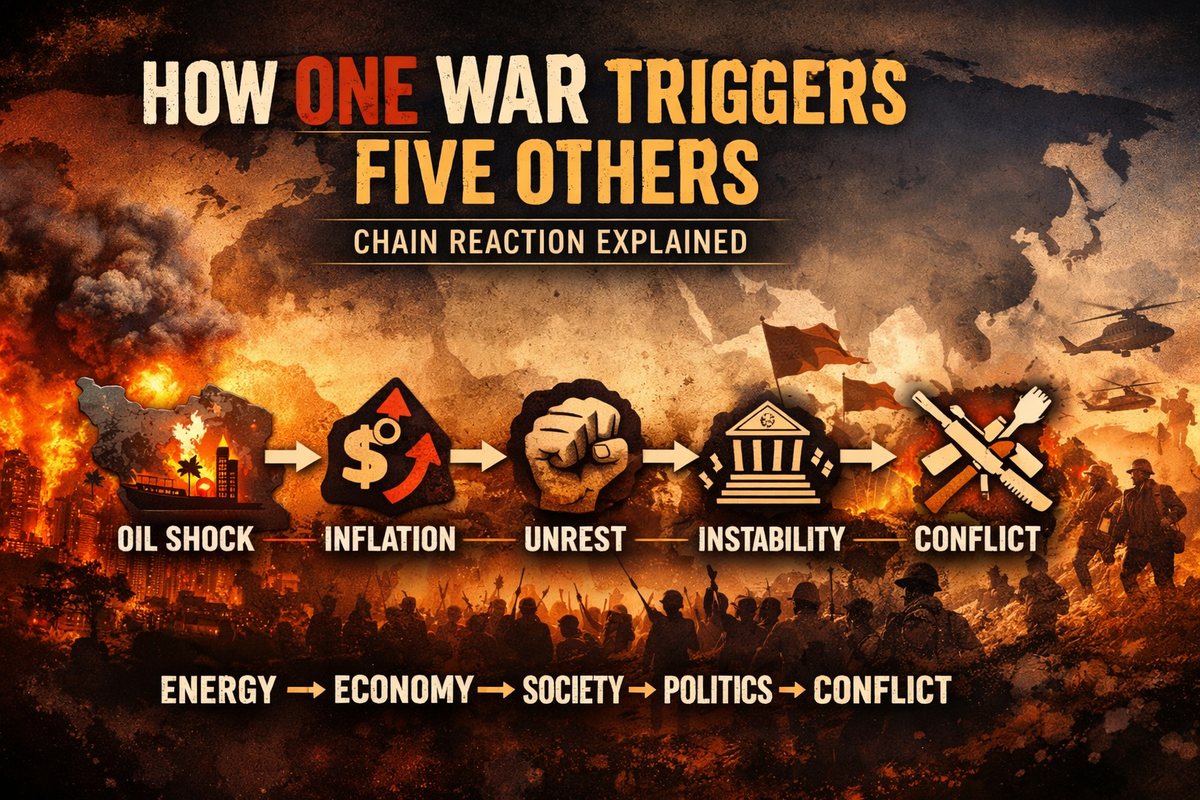
This is how global instability actually spreads.
Most people think wars stay contained.
They don’t.
Modern conflict behaves more like a system failure, not a single event. One disruption hits a critical node, and the effects cascade outward through energy, economics, and society.
Here’s the chain reaction most people miss.
1. Iran → Oil Shock
When conflict hits a region like the Middle East, it doesn’t stay local.
It hits energy first.
A huge portion of the world’s oil flows through chokepoints like the Strait of Hormuz. Disrupt that, even partially, and supply tightens fast.
That’s exactly what we’re seeing right now. The current conflict has already removed millions of barrels per day from global supply and pushed oil prices sharply higher.
This is step one.
Not bombs.
Energy.
2. Oil Shock → Inflation
Oil is not just fuel.
It’s embedded in everything:
- Transportation
- Food production
- Manufacturing
- Heating and electricity
When oil spikes, everything costs more.
Economists call this a supply shock, and it is one of the fastest ways to trigger inflation across an entire economy.
Higher oil prices force businesses and households to spend more on energy, leaving less for everything else.
Prices rise. Growth slows.
That’s the beginning of pressure.
3. Inflation → Unrest
This is where things shift from economics to human behavior.
When prices rise faster than wages:
- Food becomes harder to afford
- Fuel costs spike
- Rent and essentials increase
- Governments look ineffective
People feel it quickly.
History shows this pattern clearly. Inflation erodes living standards, and when that happens, protests, strikes, and civil unrest follow.
Not because people suddenly become political.
Because they can’t afford to live the same way anymore.
4. Unrest → Political Instability
Once unrest starts, governments get tested.
Some respond with:
- Subsidies
- Price controls
- Crackdowns
- Emergency powers
Others fail to respond at all.
Either way, trust erodes.
And when trust erodes:
- Elections become volatile
- Leadership changes accelerate
- Extremes gain traction
- Internal divisions deepen
At this point, the system is no longer stable.
It’s reactive.
5. Instability → More Conflict
Now the loop closes.
Political instability creates:
- Weak governments
- Power vacuums
- Opportunistic rivals
- Regional spillover
Countries under pressure may:
- Escalate external conflicts to unify internally
- Lose control of borders or factions
- Trigger proxy wars
- Collapse into deeper crisis
And just like that, one war has now created the conditions for multiple new ones.
The Big Insight Most People Miss
This isn’t random.
It’s a system.
A single disruption in a critical node like energy spreads through:
Energy → Economy → Society → Politics → Conflict
Each layer amplifies the next.
And because everything is interconnected, the effects don’t stay local.
They go global.
Why This Matters Right Now
We’re not just watching isolated conflicts.
We’re watching pressure build across the entire system.
- Energy markets are tightening
- Inflation risks are rising
- Governments are under strain
- Populations are already stretched
That combination is what turns one crisis into many.
Not overnight.
But predictably.
Final Thought
Resilience is not about predicting the exact war.
It’s about understanding the chain reaction.
Because once you see the pattern, you realize something important:
The second and third order effects are always bigger than the first.
And they’re the ones most people are completely unprepared for.
- Advanced VPN for a free, open internet.
- Built-in next-gen antivirus to stop malware, scams, and phishing.
- One app to protect your identity, privacy, data, and devices.



Comments ()