The Current State of AI
Leaders and Latest Industry Updates
Artificial Intelligence (AI) continues to redefine the technological landscape in 2025, driving innovation across industries and sparking both excitement and debate.
The field is marked by rapid advancements, fierce competition among key players, and a growing focus on practical applications.
Thanks for reading ON AI TECH! Subscribe for free to receive new posts and support my work.
From generative models to reasoning capabilities, AI is evolving at an unprecedented pace.
The State of AI in 2025
AI in 2025 is no longer just a buzzword—it’s a transformative force integrated into everyday life, from business workflows to creative endeavors.
Generative AI, which exploded onto the scene a few years ago, remains a dominant trend, but the focus has shifted toward refining these systems for accuracy, efficiency, and real-world utility.
Multimodal models, capable of handling text, images, and even video, are gaining traction, while efforts to improve reasoning and trustworthiness are addressing some of the technology’s longstanding limitations.
Meanwhile, ethical considerations, energy consumption, and governance are becoming critical discussion points as adoption scales.
The global AI market is booming, with investments pouring in despite challenges like data infrastructure bottlenecks and workforce adaptation.
Companies are racing to stay ahead, and a handful of leaders have emerged as the pace-setters, pushing the boundaries of what AI can achieve.
The Leaders in AI and Their Latest Updates
Here’s a look at the top players driving AI innovation and their most recent developments as of March 2025:
OpenAI
- Overview: OpenAI, the organization behind ChatGPT, remains a powerhouse in AI research and deployment. Known for its large language models (LLMs), it continues to influence both consumer and enterprise applications.
- Latest Update: In late 2024, OpenAI introduced its "Orion" model, intended as a successor to GPT-4. However, reports suggest it faced challenges, particularly in coding tasks, indicating a slowdown in the dramatic leaps seen with earlier models. To address this, OpenAI has shifted focus to post-training enhancements, integrating advanced reasoning capabilities. Posts on X from early March 2025 also hint at a potential "GPT-4.5" release, though no official confirmation has surfaced as of March 14. This reflects OpenAI’s ongoing efforts to refine its models amid increasing complexity and competition.
Google Gemini
- Overview: Google, with its vast resources and decades of AI research, is a leader in integrating AI across its ecosystem, from search to cloud services. Its DeepMind division continues to pioneer foundational research.
- Latest Update: In early March 2025, Google rolled out "Gemini Code Assist," a tool aimed at developers, enhancing coding efficiency with real-time suggestions and debugging support. This builds on Google’s multimodal Gemini models, which have been steadily improving since their debut. Additionally, Google is reportedly working on next-generation models to compete with rivals like DeepSeek, focusing on efficiency and scalability, though specifics remain under wraps as of now.
Anthropic
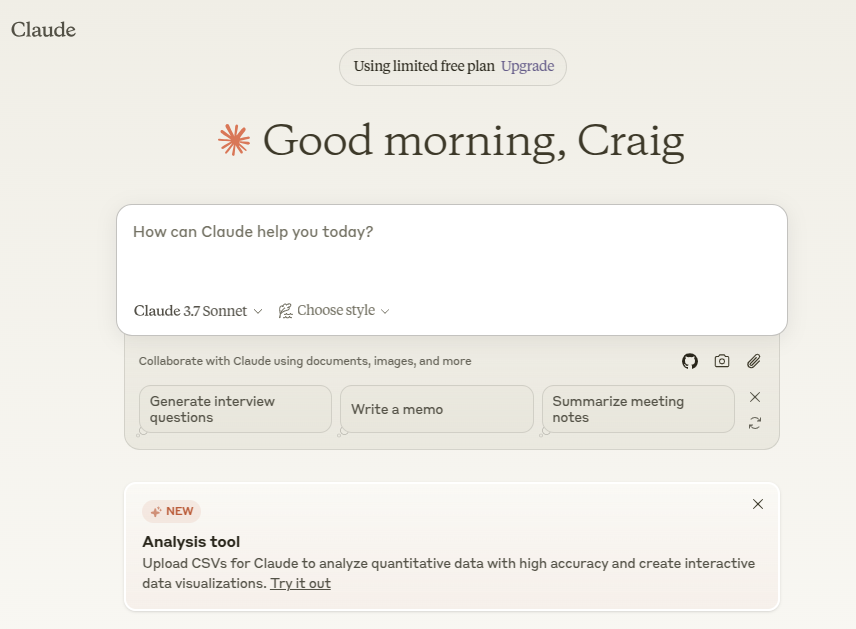
- Overview: Founded by ex-OpenAI researchers, Anthropic emphasizes safe and interpretable AI systems. Its Claude models have gained a reputation for reliability and ethical design.
- Latest Update: Anthropic made waves in early March 2025 with the release of "Claude 3.7 Sonnet," an upgraded version of its flagship model. According to posts on X, this update boasts improved performance in natural language understanding and task-specific reasoning, positioning it as a strong contender against OpenAI’s offerings. Anthropic’s focus on transparency and safety continues to resonate with enterprises wary of AI risks.
xAI - Grok
- Overview: Founded by Elon Musk, xAI aims to accelerate human scientific discovery through AI. Its Grok models are designed to provide concise, helpful answers with a unique outside perspective on humanity.
- Latest Update: On March 14, 2025, xAI released "Grok 3," which, according to the Artificial Analysis Quality Index, outperforms models from Google, Anthropic, and Meta in certain benchmarks. Paired with a new "Perplexity Voice" feature, Grok 3 enhances real-time conversational abilities, making it a standout in human-like interaction. This update underscores xAI’s rapid rise as a key player in the AI race.
Amazon
- Overview: Amazon leverages AI across its e-commerce, cloud (AWS), and consumer products like Alexa. Its scale and infrastructure give it a unique edge in practical AI deployment.
- Latest Update: In early March 2025, reports surfaced that Amazon is developing a "hybrid reasoning" model to compete with industry giants. This model aims to blend symbolic reasoning with neural networks for more robust problem-solving. Additionally, the "Alexa+" AI assistant, teased in recent weeks, promises enhanced conversational abilities, signaling Amazon’s ambition to reclaim ground in the consumer AI space.
DeepSeek
- Overview: A lesser-known but rapidly rising player, DeepSeek, based in China, has garnered attention for its high-performing models at a lower cost, challenging Western dominance.
- Latest Update: In late February 2025, DeepSeek launched "R1," a model praised on X for its efficiency and quality, prompting speculation about its implications for competitors like Google. While details are scarce, R1’s success highlights the growing influence of non-U.S. players in the AI landscape.
Emerging Trends and Challenges
Beyond these leaders, the AI ecosystem is buzzing with activity.
Companies like Alibaba (with its "Wan 2.1" AI video tool) and ElevenLabs (advancing speech-to-text) are pushing niche innovations, while firms like Cohere and Coreweave bolster infrastructure and enterprise solutions.
However, challenges loom large: diminishing returns on larger models, escalating energy demands, and the need for better governance are testing the industry’s momentum.
Leaders are responding by diversifying approaches—focusing on efficiency, multimodal capabilities, and responsible AI—rather than just scaling up.
Looking Ahead
The AI race is more dynamic than ever. OpenAI, Google, Anthropic, xAI, Amazon, and DeepSeek lead the charge, each carving out distinct strengths.
Whether it’s OpenAI’s reasoning tweaks, Google’s developer tools, or xAI’s conversational leaps, the latest updates signal a maturing field where practical impact trumps hype.
Yet, as competition intensifies and global players like DeepSeek rise, the future of AI leadership remains anything but certain.
One thing is clear: the next breakthrough is just around the corner, and it’s an exciting time to watch this space evolve.
What do you think the next big AI milestone will be?
Let me know in the comments.
Thanks for reading ON AI TECH! Subscribe for free to receive new posts and support my work.


Comments ()